Why Organizations Are Breaking: They Were Built for a Different Era.
Organizations were built for a world where information was scarce, communication was slow, and coordination was costly. AI changes those assumptions. The real question is no longer where AI fits - but whether today’s workflows still make sense.
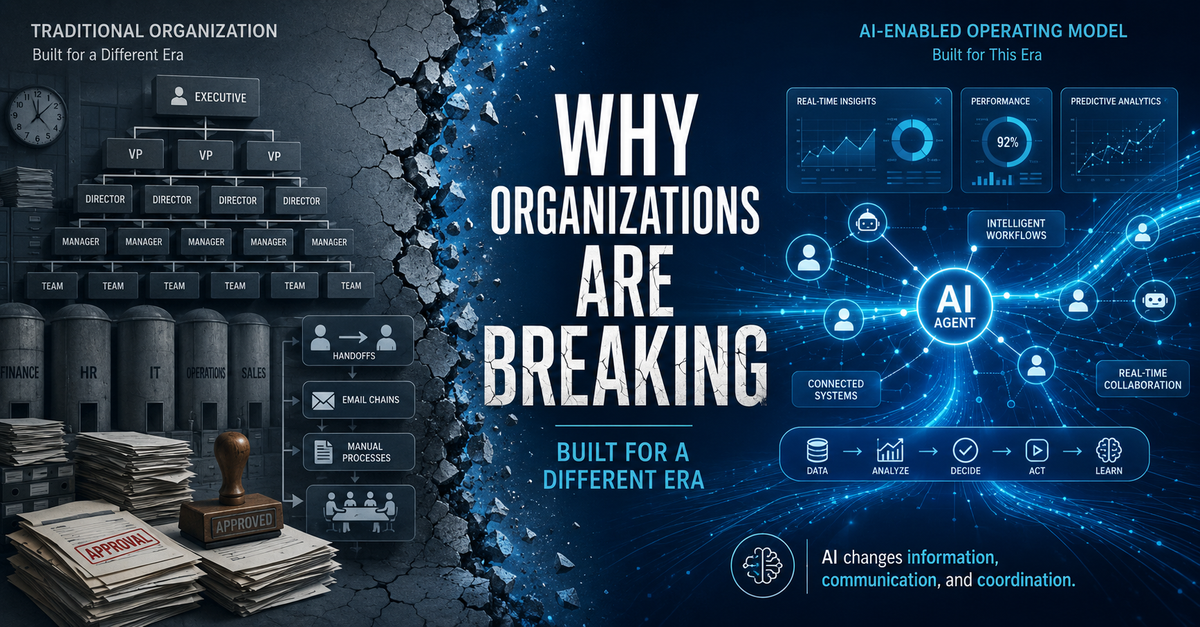
Most organizations are not badly designed. They are simply designed for a world that is disappearing.
For decades, companies evolved around constraints that seemed almost permanent: information was scarce, communication was slow, and coordinating people was expensive.
Organizations responded rationally. They created management layers to move information upward and decisions downward. They built specialist functions because expertise had to reside somewhere. They introduced reporting structures so leaders could understand what was happening, approval processes to manage risk, meetings to synchronize people, and handoffs to move work between different areas of expertise.
Much of what we now describe as bureaucracy was once a practical solution to very real problems. The difficulty is that those underlying constraints are changing much faster than the organizations built around them.
And AI is accelerating that change.
The Organization Was Built Around Three Constraints
The first constraint was information scarcity.
Getting the right information required effort. Someone had to collect it, reconcile it, organize it, analyze it, and prepare it for somebody else.
Think about a traditional management report. Data might be extracted from several systems, moved into spreadsheets, checked by analysts, discussed by managers, converted into slides, and eventually presented to leadership. By the time the information reached the decision-maker, days or even weeks could have passed.
Organizations therefore created reporting teams, analysts, coordinators, management information functions, and governance structures partly to move information through the enterprise.
The second constraint was slow communication.
Technology eventually made transmitting information fast, but understanding it remained slow. Hundreds of emails could surround a project. Decisions lived inside meeting notes, presentations, chats, spreadsheets, and systems. Someone still had to read everything and figure out what mattered.
Managers and coordinators became communication hubs because someone needed to connect the dots across organizational boundaries.
The third constraint was the high cost of human coordination.
Getting ten people aligned usually meant meetings. Getting five departments aligned meant more meetings. Add vendors, finance, technology, security, legal, regulators, and executives, and suddenly coordination itself became a major organizational activity.
So we created committees, steering groups, PMOs, approval forums, escalation paths, status meetings, and layers of management.
Again, these structures were not irrational. They were mechanisms for coordinating humans when coordination was expensive.
AI Changes the Economics
AI is often described as another productivity technology. I think that understates what is happening.
AI changes some of the underlying economics around which organizations were designed.
Information that once required hours of reading can now be summarized almost instantly. Large sets of documents can be compared automatically. Project portfolios can be continuously analyzed for risks, dependencies, delays, and inconsistencies.
A manager could ask, “What changed across my portfolio this week?” Instead of waiting for twelve teams to prepare updates, an AI-enabled system could gather information from approved sources, reconcile it, identify exceptions, and produce a concise briefing.
The same shift is happening with analysis. Historically, analysis was constrained by analyst capacity. Someone had to build the spreadsheet, inspect the data, develop scenarios, identify patterns, and explain the implications.
Increasingly, much of that analytical preparation can be generated on demand.
This does not eliminate human judgment. It reduces the effort required to create the information upon which good judgment depends.
And perhaps the biggest change is coordination.
AI systems are beginning to move beyond answering questions. Agentic systems can monitor events, call tools, request information, compare responses, update systems, generate documents, trigger workflows, and escalate exceptions.
Once software can actively participate in coordination, we have to ask whether structures designed primarily to coordinate humans remain the best way to organize work.
Imagine Designing the Workflow Again
Consider a typical enterprise process: an employee requests funding for a new initiative.
The request goes to a manager. Finance checks the budget. Technology assesses architecture. Security reviews risk. Procurement gets involved if a vendor is required. A governance group evaluates priority. Someone prepares slides, another person schedules a meeting, questions are raised, more information is requested, and eventually a decision is made.
Every step may have a legitimate purpose. But much of the machinery exists because information is fragmented and coordination is difficult.
Now imagine designing the process today with AI available from the beginning.
The request enters an intelligent workflow. The system gathers financial, architectural, resource, security, and strategic information automatically. It identifies missing information and requests it. It checks policies and previous decisions, detects conflicts with existing initiatives, assesses predefined criteria, prepares scenarios, and routes only genuine exceptions to the appropriate humans.
Instead of ten people touching every request, specialists intervene where expertise or judgment is actually required.
That is more than automation. It is a different organizational design.
Our Processes Encode Yesterday's Limitations
This is the uncomfortable part.
Many enterprise workflows are not complicated because the underlying work is inherently complicated. They are complicated because organizations developed mechanisms to compensate for limited information, fragmented systems, scarce expertise, and costly human coordination.
Over time, those mechanisms became institutionalized.
Reports became reporting functions. Approvals became governance structures. Coordination became management layers. Expertise became silos. Meetings became permanent fixtures on calendars long after anyone remembered why they were created.
Eventually, the workaround became the operating model.
AI gives us an opportunity - and perhaps eventually forces us - to question that operating model.
The Wrong Question: “Where Can We Add AI?”
Many organizations are starting by inserting AI into existing processes.
Can AI summarize this report? Can it draft this presentation? Can it write the email? Can it help the analyst?
These are useful applications, but they leave the architecture of work largely untouched.
A more important question is:
If we designed this workflow today, knowing that AI could read, summarize, analyze, monitor, coordinate, and increasingly act, would we design the workflow this way at all?
Perhaps the weekly status report should disappear, replaced by continuous monitoring and exception-based reporting.
Perhaps five approval steps should become automated policy checks with human escalation for unusual cases.
Perhaps managers should spend less time collecting information and more time making decisions.
Perhaps specialist teams should focus less on repeatedly performing routine reviews and more on defining the rules, policies, controls, and judgment frameworks that AI-enabled workflows use.
And perhaps some workflows should simply disappear.
From Doing the Coordination to Governing It
The industrial and information-era organization depended heavily on humans moving work from one step to another.
The AI-enabled organization may operate differently.
AI systems can perform much of the continuous monitoring, information gathering, documentation, analysis, and routine coordination. Humans remain essential for judgment, accountability, ethics, negotiation, creativity, leadership, and decisions where context matters.
The human role therefore begins to move from participating in every step to supervising and governing the system of work.
A manager today may spend hours discovering what happened. An AI-enabled operating model can increasingly tell that manager what happened, what changed, why it matters, what is at risk, and where attention is required.
The manager can then focus on the question that actually needs a human:
What should we do about it?
The Organization Becomes an Intelligence System
The most interesting organizations of the next decade may not simply be organizations that use AI. They may be organizations increasingly designed around AI.
Their workflows will combine people, AI agents, software systems, data, policies, and external services. Information will move continuously rather than through periodic reporting cycles. Decisions will be supported by persistent analysis rather than occasional presentations. Governance will increasingly focus on boundaries, permissions, policies, auditability, and exceptions.
And management may gradually shift from supervising activity to designing and governing systems of work.
Which brings me to the question I keep coming back to:
If we were designing the organization today, with AI available from the beginning, would we create anything resembling the organization we currently have?
Probably not.
We are trying to introduce twenty-first-century intelligence into structures built around twentieth-century constraints.
The next phase of AI transformation will therefore not be about putting a Copilot beside every employee. It will be about reconsidering how work flows through the organization itself.
At some point, we will stop asking:
“How can AI fit into the way we work?”
And start asking the far more consequential question:
“Now that AI exists, why do we still work this way?”