Beyond Automation: The Rise of Self-Improving Applications
As coding agents become more capable, applications will begin to learn from outcomes, identify weaknesses, and propose improvements. The opportunity is significant - but only if self-improvement is governed by human oversight, rigorous evaluation, and controlled deployment.
Coding agents are becoming more capable almost every day. They can generate code, review pull requests, write tests, debug failures, refactor modules, update documentation, and increasingly work across entire software repositories rather than isolated snippets.
That raises an important question: Can we build applications that improve themselves?
The answer is yes - but only if we define self-improving carefully. There is a significant difference between an application that learns from experience under controlled conditions and one that can rewrite its own logic, deploy changes, and redefine what “better” means without oversight.
The first is a plausible and increasingly practical engineering model. The second risks creating systems that are faster, cheaper, and more autonomous - but also difficult to explain, govern, or trust.
What Is a Self-Improving Application?
A self-improving application is not necessarily one that autonomously rewrites its source code. That is the most dramatic interpretation, but not the most useful.
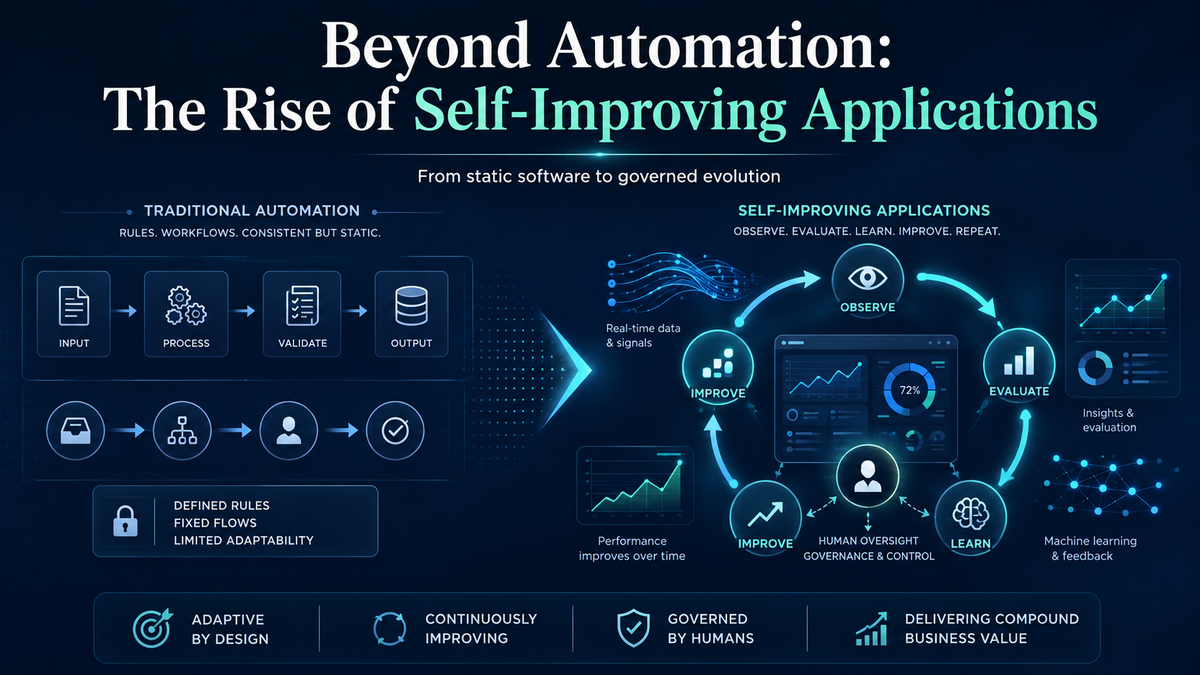
A better definition is this: A self-improving application observes its own performance, learns from outcomes, identifies weaknesses, proposes changes, validates those changes, and improves over time.
Improvement can occur across several layers. The application may refine prompts, improve retrieval relevance, select tools more accurately, route tasks more intelligently, strengthen validation, reduce latency, lower costs, improve personalization, or decrease the need for human intervention.
The application does not need to redesign itself from scratch. It needs to become measurably better at the job it was created to perform.
Most organizations should not begin by allowing an AI agent to modify production code. They should begin with a controlled improvement loop:
Observe → Evaluate → Learn → Propose → Validate → Deploy → Monitor
This is continuous improvement applied to intelligent software.
A Plausible Approach
The first requirement is observability. The application must be able to see what it did.
For every important interaction, the system should capture the original request, relevant context, retrieved information, tools called, prompt and model versions, generated output, latency, cost, validation results, user corrections, and final outcome. Without that trace, the application cannot reliably distinguish success from failure.
The second requirement is measurement. “Improved” cannot simply mean that the latest response sounds more polished. The application needs explicit measures such as task-completion rate, factual accuracy, user acceptance, number of corrections, escalation rate, retrieval quality, response time, cost per successful task, and compliance with business rules.
These measures must be balanced. A system optimized only for speed may become less accurate. One optimized only for user approval may learn to tell people what they want to hear. One optimized only for cost may select weaker models for tasks that require deeper reasoning.
The third requirement is meaningful feedback. Feedback can come from users, experts, business outcomes, system validations, or downstream actions. A user may approve or reject an answer. An analyst may correct a generated report. A project manager may override a risk classification. A forecast may later be compared with the actual result.
The system should learn from outcomes, not simply from whether someone clicked a thumbs-up button. Users sometimes approve confident nonsense - especially when it is attractively formatted.
The fourth requirement is failure analysis. Instead of adjusting prompts randomly whenever something goes wrong, the application should classify failures. Did retrieval return the wrong documents? Did the model invent information? Did the agent select the wrong tool? Did it use the right tool with incorrect parameters? Did the workflow stop too early? Did the response violate a required format?
Once failures are categorized, the system can identify patterns and propose targeted improvements, such as revising a prompt, updating a routing rule, adding a validator, improving retrieval metadata, creating a new evaluation case, or selecting a different model.
The Application Should Propose - Not Freely Deploy
This is where coding agents become particularly valuable. A capable agent can analyze failed runs, inspect the relevant components, propose a fix, generate code, write tests, update documentation, and prepare a pull request.
That is already a powerful form of self-improvement. It does not mean the agent should push changes directly into production.
A safer process is:
Production evidence → Failure analysis → Improvement proposal → Automated testing → Human approval → Staging → Canary release → Production monitoring
This allows AI to perform much of the investigation and implementation while preserving oversight and accountability.
The real opportunity is not simply autonomous code modification. It is reducing the time between discovering a weakness and implementing a verified improvement.
Today, an application failure may require someone to review logs, reproduce the issue, identify the responsible component, design a fix, write tests, create a pull request, and coordinate deployment. In a self-improving architecture, coding agents could perform much of that work and bring a tested proposal to a human reviewer.
The application would participate in its own evolution without being given unrestricted control over it.
Why Humans Must Remain in the Loop
Human involvement is not merely a temporary limitation that will disappear when AI becomes smarter. It is a governance requirement.
An application can optimize what it has been instructed to measure, but it may not understand the wider consequences. A customer-service system rewarded for customer satisfaction may begin issuing refunds too freely. A project-management system rewarded for concise reporting may remove uncertainty that executives need to see. A risk system rewarded for reducing false alarms may become less sensitive to emerging threats.
In each case, the system may improve its target metric while making the overall business worse.
Humans must remain responsible for defining what improvement means, resolving conflicts between metrics, assessing operational and ethical consequences, approving high-impact changes, and maintaining accountability.
The level of human control should be based on risk. A writing assistant might automatically deploy a better formatting prompt after passing predefined tests. An application influencing credit, employment, healthcare, legal, or investment decisions should operate under much stricter controls.
Human-in-the-loop design should therefore be risk-based. Low-risk changes can move through more automated pathways, while high-impact changes require stronger evidence, expert review, and explicit approval.
Versioning and Rollback Are Non-Negotiable
A self-improving application must version everything that influences its behavior. This includes prompts, models, retrieval configurations, tool definitions, workflows, policies, datasets, business rules, and evaluation criteria.
Every output should be traceable to the exact configuration that produced it. Otherwise, when performance improves or deteriorates, no one will know why.
Every improvement must also be reversible. The system should support shadow testing, A/B testing, feature flags, canary deployment, and automatic rollback.
A change that performs well during offline evaluation may fail under real-world conditions. User behavior may differ, data may shift, an edge case may emerge, or a revised prompt may improve common requests while damaging a less frequent but critical workflow.
Self-improvement without versioning and rollback is not learning. It is gambling with production.
An Adoption Roadmap
Organizations should adopt self-improving applications gradually.
Stage 1: Build an observable application
Capture interactions, decisions, tool calls, prompts, models, outcomes, latency, errors, and cost. The objective is to understand what the application is actually doing.
Stage 2: Build a measurable application
Define performance metrics, create evaluation datasets, classify failures, and establish baseline performance across normal requests, edge cases, security scenarios, and compliance-sensitive situations.
Stage 3: Introduce AI-assisted improvement
Allow the system to identify recurring failures and recommend targeted changes. Coding agents can revise prompts, generate tests, update workflows, modify configurations, and prepare pull requests for human review.
Stage 4: Introduce controlled experimentation
Allow the application to test alternative prompts, retrieval settings, models, tools, and workflow paths in isolated environments. Successful candidates can then be evaluated using historical data, shadow traffic, A/B tests, or limited releases.
Stage 5: Allow governed self-improvement
Low-risk changes may move automatically through predefined approval gates, provided they pass accuracy, security, cost, reliability, and compliance thresholds. High-risk changes should continue to require explicit human approval.
This maturity model matters because many teams will be tempted to jump directly to autonomous improvement without first building the necessary observability, evaluation, testing, and governance foundations. That is like installing autopilot before adding instruments to the cockpit.
From Static Software to Evolving Systems
As AI systems become more capable, self-improving applications will progressively become the norm. Users will expect applications to learn from repeated corrections. Businesses will expect systems to adapt to changing policies, data, workflows, and market conditions. Development teams will increasingly expect coding agents to identify technical debt, investigate failures, propose improvements, generate fixes, and validate changes.
The boundary between using an application and improving it will become less distinct. Applications will monitor their own performance, explain weaknesses, recommend changes, conduct controlled experiments, and participate in their own evolution.
However, the strongest systems will not be those that change most aggressively. They will be the systems that improve with evidence, governance, traceability, restraint, and a clear understanding of business consequences.
The future is not software that rewrites itself whenever it has a new idea. It is software that recognizes when it is underperforming, understands why, proposes a better approach, proves that the change works, and introduces it safely.
That is the real promise of self-improving applications: not uncontrolled autonomy, but controlled evolution.