The New Software Engineering Organization: Four Teams for the AI Era
AI is not just changing how software gets built—it is reshaping how Software Engineering itself is organized. Four teams are emerging around business proximity, product ownership, AI intelligence, and shared enterprise platforms.
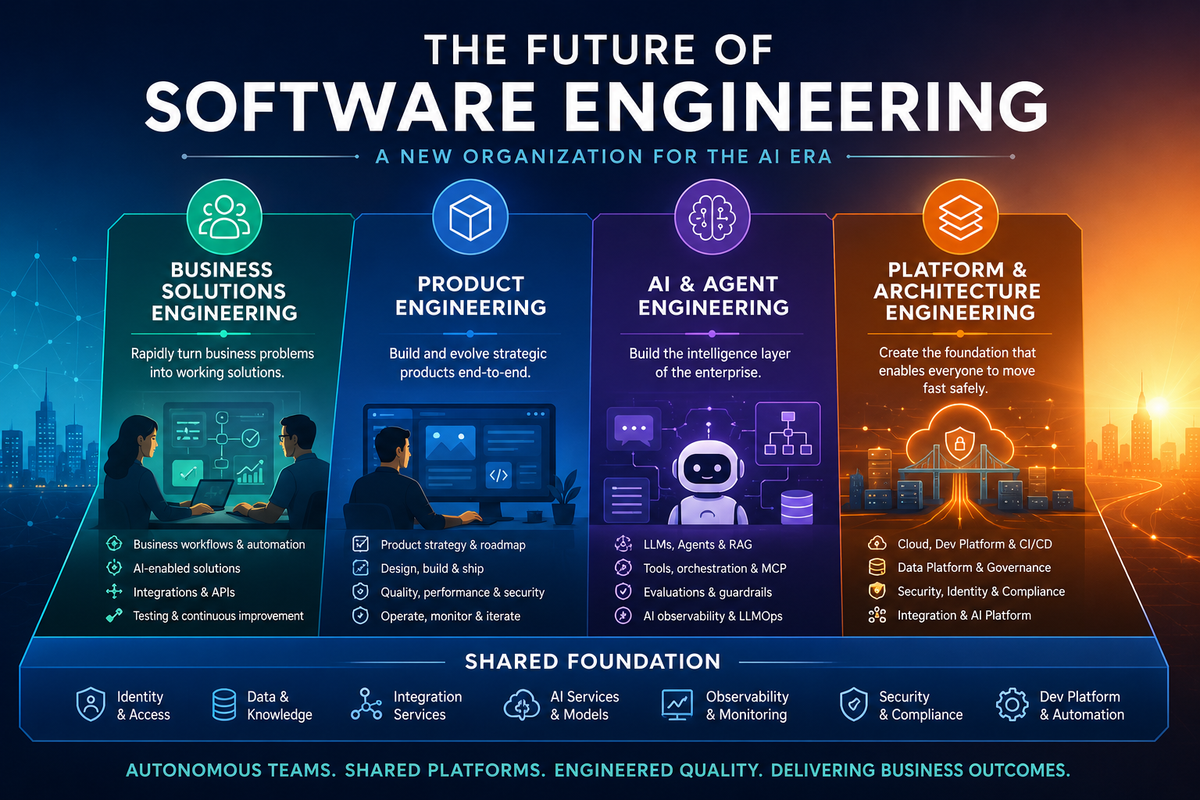
AI is not just changing how software is built. It is changing how Software Engineering organizations themselves should be structured.
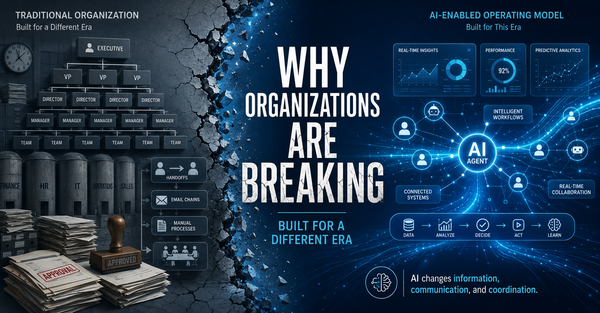
The traditional model—business analysts, developers, QA teams, architects, DevOps, data teams, and infrastructure specialists working through multiple handoffs—was designed for an era when software development was relatively slow and specialized.
That model is beginning to compress.
AI-assisted development allows smaller teams to build more, move faster, and take broader ownership. At the same time, the explosion of applications, agents, integrations, and data access makes enterprise platforms, architecture, security, and governance even more important.
A plausible Software Engineering structure for the AI era is emerging around four major teams:
- Business Solutions Engineering
- Product Engineering
- AI & Agent Engineering
- Platform & Architecture Engineering
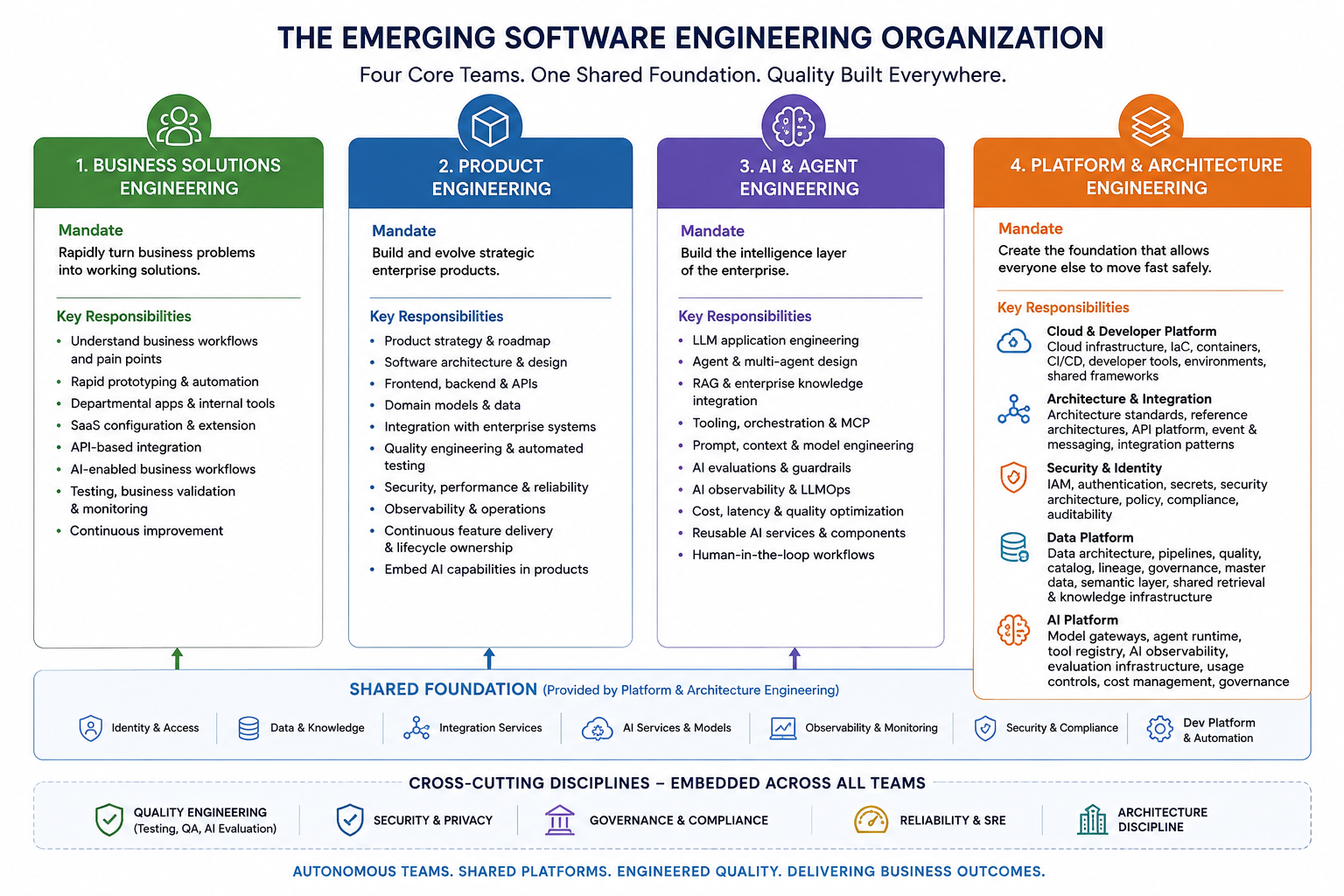
1. Business Solutions Engineering
Mandate: Rapidly turn business problems into working solutions
This team sits closest to the business.
Its purpose is to solve business problems quickly by combining AI, automation, APIs, SaaS platforms, low-code tools, and targeted custom development.
Instead of every requirement moving through a long chain of analysis, architecture, development, QA, and deployment, small business-facing engineering teams can increasingly take a problem from discovery to production.
Typical responsibilities include:
- Understanding business workflows and pain points
- Rapid prototyping
- Workflow automation
- Departmental applications and internal tools
- SaaS configuration and extension
- API-based integration
- AI-enabled business workflows
- Testing and business validation
- Production monitoring and continuous improvement
The key is that this should not become uncontrolled shadow IT.
Business Solutions Engineering moves fast because it builds on approved platforms, security standards, identity controls, data services, and architectural guardrails provided by Platform & Architecture Engineering.
The principle is simple:
Decentralize solution creation while centralizing the guardrails.
2. Product Engineering
Mandate: Build and evolve strategic products
Not every application should be treated as a rapid business solution.
Organizations will still have strategic products and enterprise applications that require long-term ownership, scalability, strong domain models, reliability, and continuous investment.
That is the role of Product Engineering.
These teams own products end-to-end: design, development, testing, deployment, operation, and continuous improvement.
Typical responsibilities include:
- Strategic applications and digital products
- Product architecture
- User experience
- Frontend and backend development
- APIs and business logic
- Product-specific data models
- Integrations
- Reliability and performance
- Automated testing
- Security implementation
- Observability
- Technical debt management
- Production support
- Continuous feature development
- Embedding AI capabilities into products
AI will also blur traditional frontend, backend, QA, and DevOps boundaries. Smaller product teams will increasingly be able to take responsibility for a broader portion of the stack.
The operating principle becomes:
Build it, run it, understand it, improve it.
3. AI & Agent Engineering
Mandate: Build the intelligence layer of the enterprise
AI introduces a new engineering discipline that does not fit neatly into traditional application development.
AI & Agent Engineering is responsible for turning foundation models into reliable enterprise capabilities.
Its role goes far beyond simply calling an LLM API. Enterprise AI systems increasingly combine models, enterprise data, retrieval, tools, agents, evaluation, observability, permissions, and human oversight.
Typical responsibilities include:
- LLM application engineering
- Agent and multi-agent design
- Tool calling and orchestration
- RAG and enterprise knowledge integration
- Embeddings and retrieval
- Prompt and context engineering
- Model selection and routing
- Structured generation
- State and memory management
- AI evaluations
- Hallucination and grounding checks
- AI observability
- LLMOps and agent operations
- Cost and latency optimization
- Guardrails and safety
- Human-in-the-loop workflows
- Reusable AI services
One critical responsibility is evaluation.
Traditional applications can usually be tested against deterministic outcomes. AI systems are probabilistic. Quality therefore expands to include accuracy, grounding, retrieval quality, agent behavior, robustness, safety, latency, and regression testing across model changes.
AI evaluation becomes a core engineering discipline in its own right.
4. Platform & Architecture Engineering
Mandate: Create the foundation that allows everyone else to move fast safely
As software becomes easier to create, platform and architecture become more important—not less.
Without strong foundations, rapid development can quickly create duplicated integrations, inconsistent security, uncontrolled AI usage, fragmented data, rising cloud costs, and technical debt.
Platform & Architecture Engineering provides the common foundation on which the other three teams build.
Its job is to make the right way the easiest way.
Key responsibilities include:
Cloud and Developer Platform
- Cloud infrastructure
- Containers and compute
- CI/CD
- Infrastructure as Code
- Development environments
- Shared frameworks
- Deployment pipelines
Architecture and Integration
- Architecture standards
- Reference architectures
- API platforms
- Event and messaging infrastructure
- Integration patterns
- Technology standards
Security and Identity
- Authentication and authorization
- Identity integration
- Secrets management
- Security architecture
- Policy enforcement
- Auditability
Data Platform
For most organizations, Data Engineering fits naturally here.
Responsibilities include:
- Enterprise data architecture
- Data platforms and pipelines
- Data quality
- Metadata and catalog
- Data lineage
- Governance
- Master and reference data
- Semantic layers
- Shared retrieval and knowledge infrastructure
Domain teams should still own the quality and meaning of the data they create. The model is therefore:
Centralized data platform, distributed domain data ownership.
AI Platform
The team would also provide common AI infrastructure such as:
- Model gateways
- Approved model access
- Agent runtime
- Tool registries
- AI observability
- Evaluation infrastructure
- Usage controls
- Cost management
- Governance
Where does QA go?
QA should increasingly stop being a downstream department.
Quality becomes an embedded responsibility across Business Solutions Engineering, Product Engineering, and AI & Agent Engineering.
Teams should own:
- Automated testing
- Integration testing
- Regression testing
- Business validation
- Production monitoring
- AI evaluation where relevant
A central platform or quality-enablement capability can provide tooling and standards, but quality should be built into engineering rather than handed off after development.
The same principle applies to security, reliability, and architecture.
These become disciplines practiced everywhere rather than gates at the end of the process.
The emerging model
The four teams ultimately provide four different forms of engineering leverage:
Business Solutions Engineering provides proximity
It brings technical capability directly to business problems.
Product Engineering provides ownership
It owns strategic products throughout their lifecycle.
AI & Agent Engineering provides intelligence
It creates reusable AI capabilities that enhance applications and workflows.
Platform & Architecture Engineering provides scale and control
It gives every other team the infrastructure, architecture, security, data, and governance needed to move quickly without creating chaos.
The most interesting consequence is a seeming contradiction:
Software development becomes more decentralized, while technology foundations become more centralized.
More teams will be able to build applications, automations, and agents independently.
But they will increasingly depend on standardized enterprise platforms for identity, data, security, integration, deployment, observability, and AI governance.
That may be the defining Software Engineering structure of the AI era:
autonomous engineering teams operating on a highly standardized enterprise technology foundation.