REIMAGINE Change: Why AI Adoption Needs a Different Playbook
AI adoption is not another technology rollout. The destination itself keeps changing. Success requires organizations to reimagine work, empower experimentation, build AI fluency, create smart guardrails, and continuously adapt as AI evolves.
AI news abounds today. At one end are warnings that artificial intelligence will eliminate millions of jobs, destabilize society and perhaps even threaten humanity. At the other end is an almost utopian vision in which AI removes drudgery, amplifies human creativity and unlocks unprecedented productivity.
These debates matter. But organizations cannot wait for them to settle.
The train is already moving. Employees are experimenting with AI, competitors are embedding it into products and operations, and capabilities that looked futuristic only a year ago are quickly becoming mainstream. Organizations that wait for complete clarity may discover that clarity arrived only after their competitors had moved far ahead.
The question is no longer whether organizations should adopt AI. It is how they should adapt to AI continuously and responsibly.
That is where traditional change-management thinking starts to break down.
We know how to roll out ERP systems, CRM platforms, cloud technologies and redesigned processes. In most of these transformations, the destination is reasonably clear: there is a current state, a target state, a new system and a plan to move people from one to the other.
AI is different because the target state itself keeps changing.
Organizations are not simply implementing another technology. They are discovering how work should be done when people can collaborate with machines that research, analyze, generate, reason and increasingly take actions.
McKinsey makes a similar distinction, describing AI transformation as less linear and more dependent on experimentation, cocreation and continuous redesign of work.
That requires a different playbook.
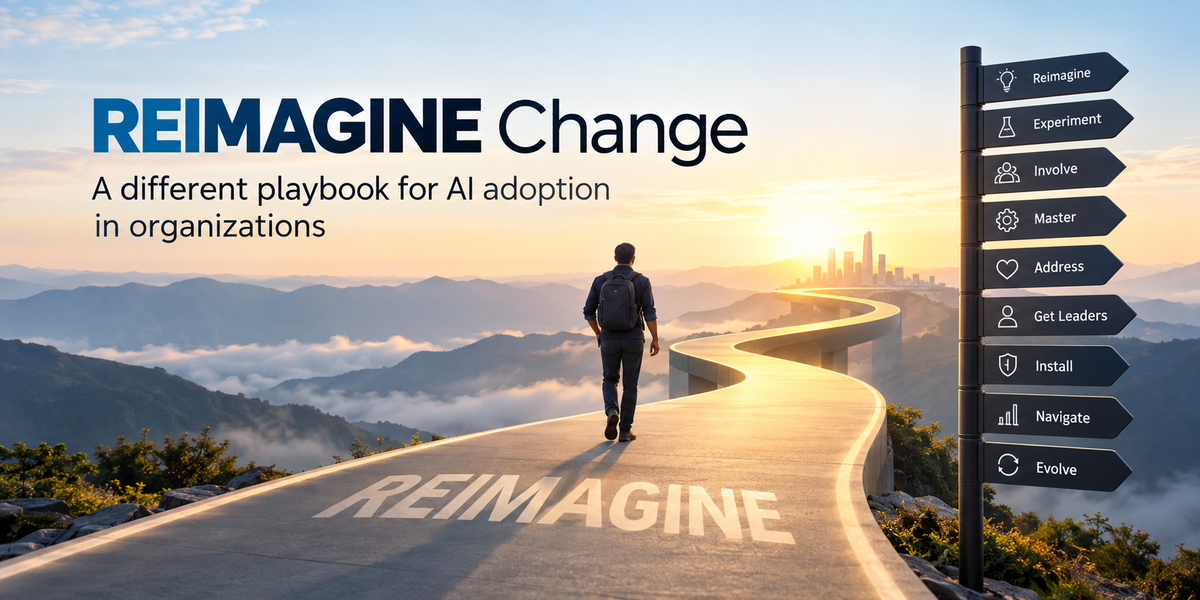
It requires organizations to REIMAGINE change.
1. (R)e-imagine Work
One of the easiest mistakes is to treat AI like another software rollout: buy licenses, conduct training, encourage usage and measure adoption.
That may create impressive statistics without changing much.
The more useful question is not, “How can employees use AI?” It is:
“If we designed this work today knowing that AI exists, would we design it the same way?”
Take a typical analyst workflow. Perhaps the analyst spends hours gathering information, preparing summaries, creating a first draft and checking data before applying judgment. Rather than inserting an AI assistant into one step, rethink the workflow. AI may gather and organize information, draft the analysis and challenge assumptions, while the analyst focuses on validation, judgment and decision-making.
BCG has highlighted this gap between AI usage and AI value: adoption can rise rapidly while business impact remains modest if AI stays peripheral to core work.
The real unit of transformation is therefore not the AI tool. It is the workflow.
Pick important workflows. Identify where time, expertise and bottlenecks sit. Then ask which steps can be eliminated, accelerated or fundamentally redesigned.
2. (E)xperiment Boldly
Traditional technology programs often emphasize standardization. AI adoption initially needs more exploration.
A central AI team cannot possibly identify every useful application across finance, operations, technology, HR, sales and specialized business functions. Many of the best use cases will be discovered by the people closest to the work.
Organizations therefore need structured experimentation: approved tools, safe environments, clear data boundaries, internal showcases and mechanisms for spreading what works.
The rhythm becomes:
Experiment → Learn → Share → Improve → Scale
Not every experiment will succeed. That is fine. Small failed experiments can prevent large failed investments.
The danger lies at both extremes. If experimentation is uncontrolled, organizations create security, privacy and reputational risk. If every experiment requires months of approvals, employees will either stop experimenting or do it quietly outside official channels.
The goal is fast learning within clear boundaries.
3. (I)nvolve Everyone
Traditional change management often treats employees as recipients of change. A project team designs the solution, change specialists communicate it, employees are trained and adoption is measured.
AI requires employees to be involved much earlier.
The claims analyst knows which parts of claims processing are repetitive. The relationship manager knows what information must be assembled before every client meeting. The software engineer knows where hours disappear into testing and documentation.
These employees hold workflow knowledge that a central AI team often does not.
So instead of asking only, “How do we get employees to adopt AI?” ask:
“How do we enable employees to redesign their own work with AI?”
That changes the sense of ownership. People tend to resist change imposed on them far more than change they helped create.
McKinsey similarly emphasizes employees becoming active participants and cocreators rather than passive users of AI.
4. (M)aster AI Fluency
AI training cannot stop with a two-hour session on prompting.
People need AI fluency: understanding what AI does well, where it is unreliable, how context affects outputs, how to validate results, how to protect sensitive information and when not to use AI.
More importantly, employees need a new form of professional judgment. As AI becomes capable of handling larger chunks of work, individuals must constantly decide:
What should I do myself? What should I do with AI? What can I delegate to AI? What should never be delegated?
That becomes even more important as organizations move from AI assistants to AI agents capable of taking actions.
Microsoft's Work Trend Index has pointed toward a future in which employees increasingly direct and supervise AI agents. If that trend continues, many employees will effectively manage a small digital workforce.
The valuable skill will not simply be producing work. It will be orchestrating work across humans and machines while remaining accountable for the result.
5. (A)ddress Job Anxiety
No AI change program can ignore the question employees are already asking:
“If I help automate what I do today, what happens to me tomorrow?”
This cannot be answered with generic assurances that AI will simply “augment people.”
Some tasks will disappear. Some roles may shrink. Other roles will expand. New roles will emerge. Most jobs will experience some combination of task elimination, enhancement and responsibility shift.
Employees deserve a credible conversation about that reality.
AI transformation should therefore be connected directly to workforce planning. If AI removes 30 percent of the administrative work from a role, what happens to the capacity created? Does the employee serve more customers, perform higher-value analysis, take on new responsibilities or move into a different role?
Those questions should be part of transformation design, not an HR afterthought.
Trust matters. Employees are more likely to participate actively in AI transformation when they can see a plausible future for themselves in the transformed organization.
6. (G)et Leaders Hands-On
AI transformation cannot be delegated entirely to the CIO, Chief AI Officer or innovation team.
Leaders need enough hands-on experience with AI to understand both its potential and its limitations. Otherwise, they will manage the transformation through presentations rather than experience.
A leader who regularly uses AI starts asking different questions. Instead of “How many people have been trained?” the question becomes, “Why does this analysis still take three days?”
Instead of looking only for cost reduction, leaders begin to see opportunities for faster decisions, better customer experiences and entirely new products.
Leadership behavior also legitimizes experimentation. When senior executives visibly use AI, discuss where it helped, acknowledge where it failed and show curiosity, they send a strong signal:
learning AI is now part of how the organization operates.
7. (I)nstall Smart Guardrails
AI adoption requires governance, but governance should enable responsible action rather than create paralysis.
Employees need simple answers to practical questions: Which tools are approved? What information can be entered? Which outputs require human verification? When can an AI agent act autonomously? Where is human approval mandatory? Who remains accountable?
If employees cannot answer those questions, many will either avoid AI entirely or use it quietly outside official channels.
Good governance therefore works like highway barriers: it defines where the road is, prevents serious accidents and still allows traffic to move.
A useful principle is maximum responsible freedom. Give people as much room as possible to experiment while making the boundaries around sensitive data, regulatory obligations and consequential decisions unmistakably clear.
8. (N)avigate by Outcomes
Organizations love adoption metrics because they are easy to measure: employees trained, licenses activated, active users, prompts per month.
But activity is not transformation.
An employee who uses AI every day to polish emails may contribute more to adoption statistics than someone who redesigns a core process and saves hundreds of hours.
Metrics therefore need to move closer to business outcomes.
Did cycle time fall? Did quality improve? Were errors reduced? Did employees gain capacity for higher-value work? Did customer response times improve? Did revenue increase? Did a major workflow actually change?
BCG has warned about the gap between adoption and meaningful value creation. The implication is simple:
The objective is not AI usage. The objective is better work and better business outcomes.
9. (E)volve Continuously
Perhaps the biggest difference from traditional change management is that AI transformation may never reach a stable “go-live.”
Models improve. Agents become more capable. Regulations evolve. New interfaces emerge. Tasks that require human involvement today may be delegable tomorrow.
Deloitte describes this as moving beyond AI adoption toward AI adaptation: organizations continuously changing how they work as AI capabilities evolve.
That means companies need a permanent mechanism for sensing new capabilities, experimenting with them, redesigning workflows, updating policies and spreading what works.
The operating model becomes cyclical rather than linear:
Sense → Experiment → Learn → Redesign → Scale → Repeat
The implication is significant. AI change management cannot remain a temporary workstream attached to an implementation project.
It becomes an ongoing organizational capability.
From Adoption to Adaptation
Traditional change management essentially says:
“Here is the new way of working. We will help you adopt it.”
AI change management says something quite different:
“Here is a rapidly evolving capability. Together, we need to keep discovering how our work, roles and organization should evolve around it.”
That changes the role of everyone involved. Leaders become active learners. Employees become cocreators. Training becomes continuous capability building. Governance becomes guardrails. Processes become experiments. Adoption metrics give way to business outcomes.
And change itself stops being an event.
It becomes part of how the organization operates.
That may ultimately determine which organizations succeed with AI. Access to powerful models will increasingly become commonplace. The long-term differentiator will not simply be who has AI.
It will be which organizations learn fastest how to reorganize themselves around what AI makes possible.
The technology is already moving.
The real question is whether the organization can REIMAGINE itself quickly enough to move with it.