Vibe Coding Is Not One Thing: From Weekend Hacks to Agentic Engineering
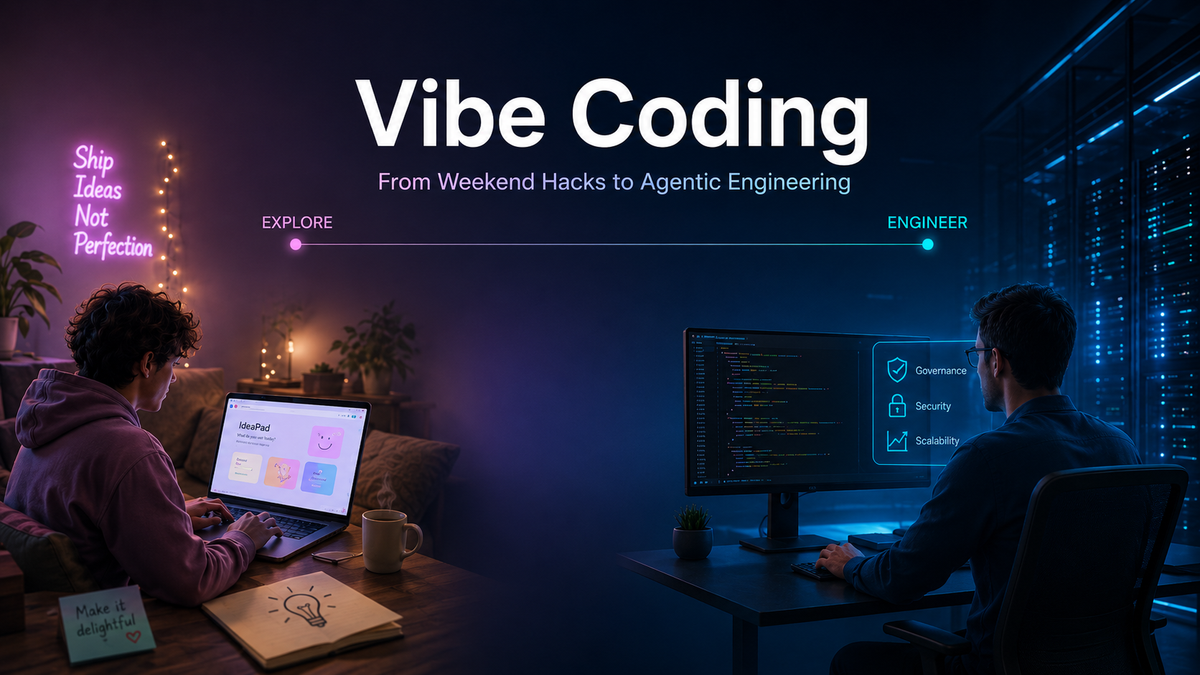
Vibe coding is not one thing. It spans from playful weekend hacks to disciplined agentic engineering. The real question is not whether AI writes code, but who owns, validates, and governs what it creates.
The first time I tried vibe coding, I was genuinely astounded.
In a couple of hours, I created a split-bill app that could scan a restaurant bill, identify what each person ordered, and allocate the cost among individual diners. It was not perfect. It was not production-ready. But it was good enough to make me pause and ask an uncomfortable question:
If this is the new world of application development, what happens to software engineering?
That question has only become more important.
Vibe coding has moved far beyond playful experiments. Tools like Claude Code, Codex, Copilot, Cursor, and other AI coding assistants are now being used to build, refactor, test, debug, and reason across real codebases.
But here is the catch: not all vibe coding is the same.
It is better understood as a spectrum - from casual experimentation at one end to disciplined agentic engineering at the other.
One end creates demos. The other creates systems.
One end creates energy. The other creates accountability.
And confusing the two is how weekend hacks accidentally wander into enterprise production wearing flip-flops.
The Vibe Coding Spectrum
1. Casual Vibing
This is where many people first experience the magic.
You have an idea. You describe it to an AI tool. It generates code. You run it. Something breaks. You paste the error back. It fixes something. You repeat until the app looks like it works.
A non-developer can build a small app. A student can learn faster. A consultant can create a demo. A business user can automate a painful workflow.
Casual vibing lowers the barrier to creation. But it also lowers the barrier to creating bad software. The user may not understand security, data handling, architecture, dependencies, performance, or error handling.
It is great for learning and experimentation.
It is not a shortcut to enterprise software.
2. Prototype Vibing
This is where organizations start to get interested.
A business team wants to visualize a new process. A product team wants a clickable demo. An innovation team wants to show what an AI-powered workflow could look like.
Instead of spending weeks writing requirements documents and PowerPoint slides, teams can build working prototypes in days, sometimes hours.
That is powerful because many stakeholders do not know what they want until they see it.
But prototypes become dangerous when they are mistaken for products. A prototype may have no authentication, secure data model, test coverage, scalability, observability, or support. It may look like software, but under the hood it may be duct tape, hope, and three API keys named final_final_real_key.
Prototype vibing is excellent for discovery.
Production requires discipline.
3. Guided Vibe Coding
Then comes guided vibe coding.
Here, the human gives the AI more structure. Instead of saying, “Build me a CRM,” the user provides requirements, constraints, architecture choices, and acceptance criteria.
The AI is no longer guessing from a vague prompt. It is being guided.
This flavor is powerful for semi-technical users, business analysts, consultants, product owners, and citizen developers. They may not be professional software engineers, but they understand the business process deeply.
The risk is shadow IT. If every department starts building AI-generated tools without IT oversight, the organization may end up with fragmented systems, duplicated logic, unmanaged data, and security exposure.
Guided vibe coding works best inside a fenced garden: approved tools, reusable templates, secure data access, review gates, and clear rules on what can and cannot go live.
4. Developer-Augmented Coding
Now we enter professional software engineering.
Developers use AI coding assistants as pair programmers. AI helps generate functions, write tests, explain legacy code, refactor modules, debug failures, and produce documentation.
This is not casual vibing anymore.
The developer remains in control. The developer understands the codebase, reviews the output, and knows when the AI is making things up with great confidence.
This flavor does not eliminate software engineering. It changes the work. Developers spend less time on boilerplate and more time on judgment, design, review, integration, and problem solving.
The key risk is complacency. AI can produce code quickly. It can also produce bad code quickly. Speed is not the same as quality.
5. Structured AI-Assisted Engineering
At the next level, AI becomes part of the software delivery lifecycle.
It can assist with requirements analysis, story decomposition, architecture drafts, code generation, test generation, security review, documentation, release notes, and incident analysis.
But the important word is structured.
AI-generated code must pass through the same discipline as human-written code: architecture standards, code review, test coverage, CI/CD, security scans, dependency checks, observability, and release governance.
This is where serious organizations should aim first. Not because it is the flashiest model, but because it is survivable.
AI can generate.
The delivery system must validate.
6. Agentic Engineering
Then comes agentic engineering.
AI agents do more than generate snippets. They can read a codebase, understand an issue, create a plan, modify files, run tests, fix errors, update documentation, and prepare a pull request.
The human role shifts again. The developer becomes an orchestrator, reviewer, architect, and accountable owner. The human defines the objective, provides context, sets constraints, reviews the work, and decides what is acceptable.
The risk is autonomy without governance.
An unsupervised agent can change many files very quickly. That is powerful. It is also dangerous.
7. Enterprise Agentic Delivery
At the far end is enterprise agentic delivery.
Here, AI agents become part of the software delivery operating model. Different agents may support business analysis, architecture review, code implementation, test automation, security scanning, data validation, deployment readiness, and production support.
This is where the real transformation happens.
But this is also where governance becomes non-negotiable.
Organizations need role-based access, secure sandboxes, approved toolchains, audit trails, policy-as-code, secrets management, compliance checks, cost controls, model governance, and clear human accountability.
Without those controls, enterprise agentic delivery simply industrializes chaos.
How Organizations Are Adopting the Spectrum
Organizations are not adopting vibe coding as a single practice. They are absorbing it in layers.
- Casual vibing enters through individuals.
- Prototype vibing enters through innovation teams.
- Guided vibe coding enters through power users and citizen developers.
- Developer-augmented coding enters through engineering teams.
- Structured AI-assisted engineering enters through the SDLC.
- Agentic engineering enters through platform teams and controlled pilots.
- Enterprise agentic delivery enters only when governance, security, observability, and accountability catch up.
Most organizations move through five phases: uncontrolled experimentation, approved tools, team pilots, SDLC integration, and finally an agentic operating model.
In the first phase, people use public tools quietly. Value appears. Risk appears. Policy is unclear. This is the “everyone is doing it, nobody is admitting it” phase.
Then organizations introduce enterprise-grade tools, basic rules, and clear restrictions on secrets, customer data, and proprietary code.
Next, they run team pilots and measure productivity, code quality, defects, test coverage, cycle time, developer satisfaction, security findings, and cost per workflow.
Then AI becomes part of the delivery pipeline - connected to backlog management, repositories, CI/CD, testing, security scanning, documentation, release management, and observability.
Finally, organizations define which agents exist, what they can access, what they can do, which actions require approval, how outputs are validated, how incidents are handled, how performance is measured, and who is accountable.
That last question matters most.
The Real Distinction
The real distinction is not whether AI writes the code.
The real distinction is where accountability lives.
At the casual end, accountability is vague:
“The AI built it.”
At the disciplined end, accountability is explicit:
“The engineering organization used AI to build it, validated it, secured it, and owns it.”
That is the whole game.
Every organization will need to find its own place on this spectrum based on its business model, risk appetite, engineering maturity, regulatory exposure, and culture.
There is no one-size-fits-all answer.
But there is one clear warning: do not confuse creation with engineering.
Vibe coding can create.
Engineering must validate.
Agentic delivery can scale.
Governance must contain it.
The future of software development is not simply that everyone will code by vibes. The future is that business teams will express ideas faster, developers will deliver faster, agents will perform bounded engineering tasks, platforms will enforce guardrails, and humans will remain accountable.
So the question is not:
“Will you adopt vibe coding?”
You probably already have.
The better question is:
Which flavor of vibe coding is right for you - and are you ready to own what it creates?