Agile Meets AI: The Delivery Model Needs an Upgrade
Agile is not dead. But in the age of AI, it can no longer survive as ceremony theater. As AI accelerates coding, testing, documentation, and delivery, Agile must evolve into a sharper operating model — one powered by AI, governed by humans, and measured by business value.
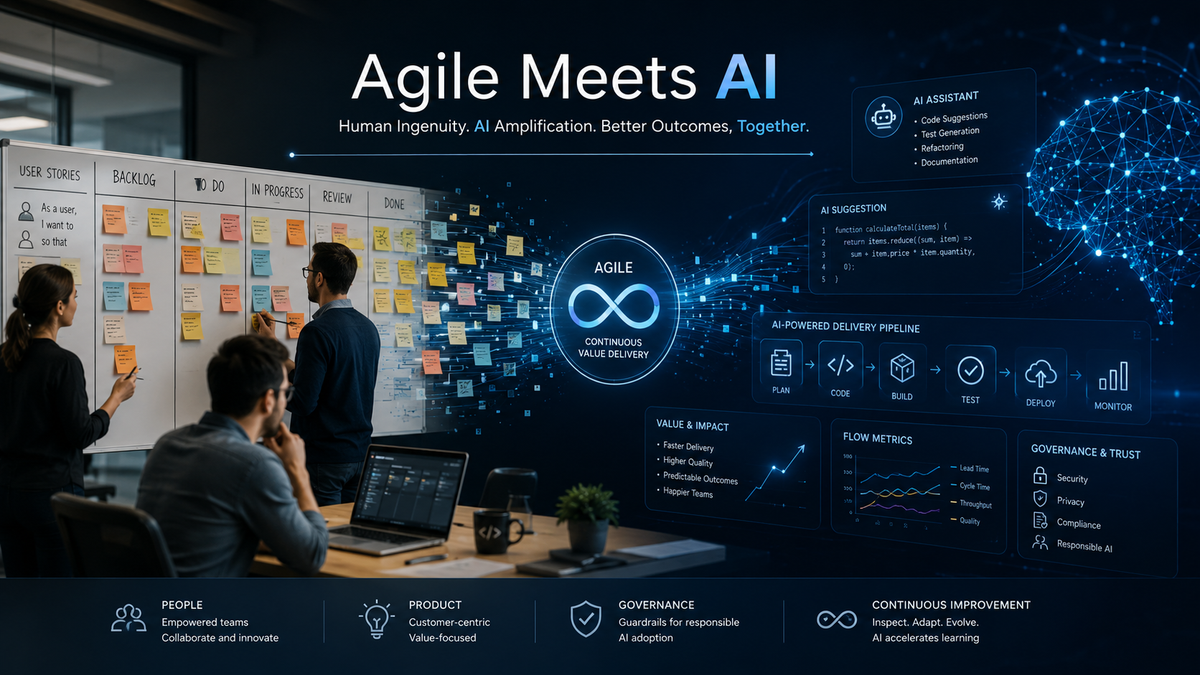
Not long ago, Agile was the new kid on the software delivery block.
Waterfall methodology was struggling under its own weight. Projects took too long. Requirements changed before systems went live. Customers got frustrated. ROI often arrived so late that no one remembered why the project started in the first place.
Agile arrived as the antidote: shorter cycles, customer feedback, working software, adaptive planning, empowered teams. Over time, what began as a popular buzzword quietly became the new normal. It entered every enterprise playbook, transformation deck, Jira board, and standup room.
Somewhere along the way, Agile became a little too comfortable.
That's when AI walked in.
With tools like GitHub Copilot, Claude Code, Codex, Antigravity, and emerging agentic development platforms, software delivery is changing fast. AI can generate code, tests, documentation, prototypes, refactoring suggestions, and architectural options in minutes. Naturally, organizations are asking: does Agile still matter? What happens to sprints when work can be generated in hours? What happens to roles when product owners, analysts, developers, QA engineers, and architects all start using AI?
My view is simple: Agile is not dead. But Agile has to grow up.
AI does not make Agile obsolete. It makes weak Agile painfully obvious. If a team was already doing “fake Agile” - ceremonies without product thinking, story points without value, standups without decisions, Jira tickets without clarity - AI will not fix that. It will simply help the team produce bad software faster. A Ferrari engine inside a shopping cart is still a shopping cart.
Agile remains the operating system; AI becomes the new execution engine inside it.
Traditional Agile followed a familiar loop: idea, user story, sprint, code, test, demo, feedback. AI-driven Agile shifts that loop: intent, AI-assisted design, AI-generated code and tests, human review, fast validation, controlled release, production feedback.
The principles remain the same: short feedback loops, customer collaboration, working software, and adaptation. What changes is speed, role clarity, and control.
First, Agile moves from sprint delivery to continuous flow.
The classic two-week sprint may become less dominant in AI-heavy teams. If AI can generate a prototype, tests, documentation, and refactoring options in hours, waiting two weeks to inspect progress can feel artificial. That does not mean planning disappears. It means planning becomes lighter, more frequent, and more evidence-based.
The emerging model is a hybrid: Scrum keeps teams aligned, Kanban keeps work flowing, DevOps keeps delivery automated, and AI agents compress the time between idea and execution. The question is no longer only “what can we commit to this sprint?” It becomes “what value is ready to move, what requires human judgment, and what can AI safely accelerate?”
Second, user stories become more important, not less.
AI is powerful when the instruction is clear. It is also remarkably confident when the instruction is vague. A story like “As a user, I want a dashboard so I can see data” was always weak. In the AI era, it is dangerous.
A better story says: “As a portfolio manager, I want to view daily exposure by asset class, region, and counterparty so I can identify concentration risk before market open.” Then it adds acceptance criteria: refresh by 7:00 AM ET, flag threshold breaches, show data lineage, enforce role-based access, allow CSV export, and log export actions.
That level of specificity gives AI something useful to work with. It also gives humans something meaningful to validate. This is why product owners, business analysts, and domain SMEs become more valuable, not less. Their job is to define intent, business rules, edge cases, data definitions, security constraints, and non-functional requirements with much greater precision.
The BA role does not disappear. The vague BA disappears.
Third, sprint planning changes.
In traditional Agile, planning asks: what can the team build next? In AI-driven Agile, planning asks: what should humans design, review, and validate, and what can AI generate?
Business intent belongs with the product owner, BA, and domain SME. Architecture decisions belong with architects and tech leads. Boilerplate code, test scaffolding, documentation drafts, and refactoring suggestions can be AI-assisted. Security-sensitive logic, integration design, production deployment, and final accountability remain human-led.
The sprint is no longer just about assigning tasks to people. It is about allocating work across humans, AI tools, and automated pipelines.
Fourth, the developer role changes.
The developer becomes less of a pure code producer and more of an AI-enabled engineer. The old pattern was: pick up story, write code, write tests, fix bugs, commit. The new pattern is: clarify intent, break work into AI-executable tasks, generate code with AI, review output, validate architecture fit, run tests, check security, integrate safely, and document decisions.
Developers who can supervise AI, challenge its assumptions, detect subtle bugs, and understand business context will become more valuable. Developers who only wait for tickets and write isolated code will be under pressure. The keyboard is no longer the differentiator. Judgment is.
Fifth, Definition of Done becomes much stricter.
In the AI era, “done” cannot mean “AI generated it and the app runs.” That is not done. That is the robot producing something that did not immediately catch fire.
A modern Definition of Done should include human code review, reviewed tests, integration tests, security scans, no exposed secrets, architecture compliance, performance baselines, observability, documentation updates, and product owner acceptance.
For regulated industries, add audit trails, privacy review, AI tool usage records, segregation of duties, approval evidence, and rollback plans. This is where Agile and governance must finally become friends. Not meeting-room friends. Real friends.
Sixth, the ceremonies change.
Daily standups should move beyond “what did I do yesterday?” Better questions are: what business outcome moved forward? What did AI generate? What needs human review? What tests or controls failed? What decision is blocked? What risk surfaced?
Backlog refinement becomes AI-assisted. AI can help turn rough ideas into epics, stories, acceptance criteria, test scenarios, edge cases, API contracts, dependency maps, and documentation drafts. But humans still validate meaning. The AI becomes the tireless junior analyst who never sleeps. Useful, fast, and occasionally in need of adult supervision.
QA also shifts further left. AI can generate unit tests, negative tests, boundary tests, regression tests, API tests, mock data, and exploratory scenarios. But QA engineers must decide whether those tests are meaningful, risk-based, and tied to real user behavior.
Demos become more powerful - and more dangerous. AI makes it easier to show clickable prototypes, generated UI flows, API mockups, data visualizations, and workflow simulations. That is great because business users can react earlier. But stakeholders may confuse prototype speed with production readiness.
Every demo should be clearly labeled: prototype, technical spike, MVP candidate, or production-ready increment. Otherwise someone will inevitably say, “Great, can we launch Friday?” Five words that have ruined many weekends.
Finally, Agile metrics must change.
Velocity and story points become less useful when AI can generate code rapidly. Teams should focus more on cycle time, defect escape rate, rework percentage, review time, production incidents, business value delivered, cost per feature, and one new metric: AI-generated rework ratio.
How much AI-created work had to be rewritten, rejected, or heavily corrected? If AI generates 5,000 lines and humans delete 4,000, congratulations — you automated waste.
So what is the new model?
It is not pure Scrum. It is not “AI replaces Agile.” It is AI-Augmented Agile Delivery. Or, in consulting language, an Agentic SDLC Operating Model.
It has five pillars: product intent and value management, AI-assisted engineering execution, human review and accountability, automated quality and security gates, and continuous feedback from production.
Agile does not go away. But Agile theater will get exposed. The valuable parts of Agile - feedback, iteration, adaptability, working software, customer collaboration, and empowered teams - become even more important.
The future is not Agile versus AI.
The future is Agile powered by AI, governed by humans, and measured by business value.