Is Software Engineering Dead? Not Quite. But It Is Being Reborn.
AI is not killing software engineering — it is compressing and collapsing the old model. Large teams, long handoffs, late QA, and manual governance are giving way to smaller, sharper, AI-augmented squads where engineers supervise, shape, and scale intelligent delivery safely now.

Every few years, technology asks a dramatic question. Is the mainframe dead? Is the database administrator dead? Is the project manager dead? Is coding dead?
Now, with AI agents writing code, debugging applications, generating tests, reviewing pull requests, and creating prototypes from a prompt, we have reached the newest headline: Is software engineering dead?
No.
But the comfortable version of software engineering - large teams spending months writing boilerplate code, translating requirements into tickets, passing work across silos, and calling that delivery - is under threat. That version may not survive. Frankly, it should not.
What we are witnessing is not the death of software engineering. It is a tectonic shift in how software gets imagined, built, governed, tested, deployed, and improved. Roles are changing. Teams are compressing. The boundary between business and technology is blurring.
The real question is: what will software engineering become when the dust settles?
The Tempting but Dangerous Conclusion
A seductive argument is floating around boardrooms: if AI can write code, why do we need so many developers? If business users can describe what they want, why not let them build applications directly? If agents can generate, test, and deploy software, why not reduce IT headcount?
It sounds efficient. Bold. Futuristic.
It may also be an expensive mistake.
Yes, AI will reduce repetitive coding. Yes, business teams will create more prototypes and automations. Yes, “vibe coding” will become common.
But enterprise software is not just code. It is security, resilience, architecture, integration, observability, data governance, compliance, scalability, maintainability, user experience, disaster recovery, and operational accountability.
Software engineering is the discipline of turning business intent into reliable digital capability. AI can accelerate that discipline. It cannot replace it - at least not in any organization that wants to sleep peacefully at night.
The Wrong Move: Replacing Engineers with Agents
Some organizations will see AI coding agents as a simple cost-cutting opportunity: replace developers, shrink IT, and push development to business teams.
That may produce short-term savings. It may also create a long-term mess.
Without engineering discipline, AI-generated software can become the new shadow IT - only faster, larger, and harder to control. Organizations may end up with poorly documented applications, inconsistent security, duplicated logic, fragile workflows, and unclear ownership.
That is not transformation. That is technical debt with a better user interface.
The winning formula is not to remove software engineering from the equation. It is to elevate software engineering with AI.
Successful organizations will ask better questions: How can we make every engineer more productive? How can architecture move closer to execution? How can business and technology collaborate in real time? How can governance be embedded without choking innovation? How can we build faster while becoming safer?
The Emerging Shape of IT Development
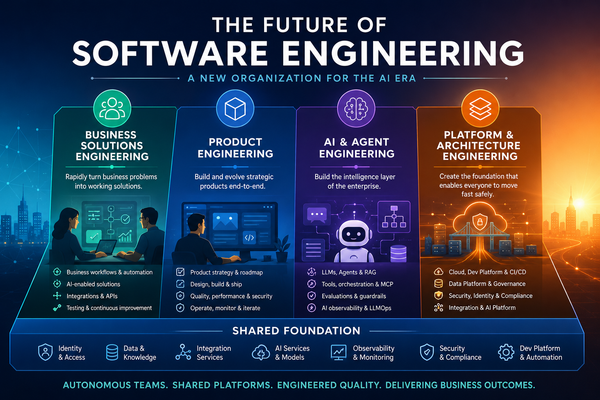
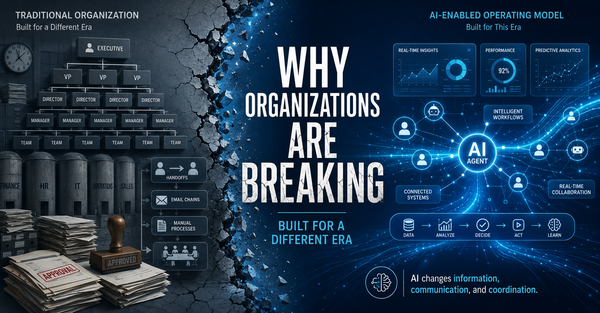
The traditional IT pyramid - large delivery teams, layered management, separate QA groups, distant architects, and business analysts translating requirements through endless documents - is cracking.
AI compresses work. It reduces handoffs. It speeds up discovery, design, coding, testing, and documentation. Teams will become smaller, sharper, more skilled, and more cross-functional.
1. Smaller Product Squads, Higher Talent Density
Large teams will give way to smaller product squads. A squad that once needed ten or fifteen people may need fewer people - but those people will need stronger judgment, broader skills, and deeper business understanding.
This does not mean everyone becomes a full-stack architect-product-engineer-designer-poet, though some job descriptions will certainly try. It means teams will be built around talent density, not headcount volume.
Productivity will come from reducing friction, eliminating repetitive work, and enabling experienced people to operate at a higher level.
2. Developers Become AI Supervisors
Developers will still code, but coding will no longer be the only measure of value. Much of the first draft may be generated by AI. The developer’s job will be to guide, review, refine, secure, optimize, and integrate that code.
They become supervisors of intelligent machines. They must ask better questions, validate outputs, detect hallucinations, understand architecture, and ensure generated code fits the enterprise context.
The skill shifts from writing every function to ensuring the solution is correct, secure, maintainable, scalable, and aligned with business intent.
That is not a downgrade. That is an elevation.
3. Platform Engineering Becomes More Important
As AI accelerates development, platform engineering becomes critical. When everyone can build faster, the organization needs stronger guardrails.
Developers and business technologists will need approved templates, reusable components, secure APIs, deployment pipelines, observability patterns, data access controls, and standardized environments.
Without a strong platform, AI-assisted development becomes chaos at machine speed. With a strong platform, it becomes scalable innovation.
4. QA Becomes AI-Augmented Quality Engineering
Traditional QA often arrives too late. Requirements are written, code is built, and QA is asked to find everything that went wrong. In an AI-driven world, that becomes absurd.
Quality must shift left.
AI can generate test cases, regression suites, edge cases, user simulations, and log analysis. But human quality engineers remain essential in defining risk, validating business outcomes, and ensuring systems behave correctly under real-world conditions.
The QA role moves from manual verification to intelligent quality engineering: less “click through this screen fifty times,” more “what could fail, why would it matter, and how do we prevent it before production?”
5. Architecture Moves Closer to Delivery
In many organizations, architecture has been too far removed from delivery. Architects produce diagrams. Delivery teams produce software. Sometimes the two even resemble each other. Occasionally.
AI will force architecture to become more practical, continuous, and embedded. When code can be generated quickly, architectural decisions become even more important. Bad design does not disappear. It compounds faster.
Architects will work directly with product squads, shaping patterns, reviewing AI-generated designs, defining integration approaches, and ensuring speed does not compromise resilience.
6. Business Analysts and Product Owners Become More Technical
Business roles will also change. Product owners and business analysts can no longer remain purely functional translators.
As AI tools allow business users to generate prototypes and workflows directly, business roles need stronger technical awareness. They do not need to become full-time engineers. But they do need to understand data flows, APIs, system constraints, security implications, prompts, and acceptance criteria.
The best business analysts will become product engineers of intent, defining not just what the business wants, but how that intent can become a responsible digital product.
This is where the business/IT divide begins to collapse - not because business replaces IT, but because both sides become fluent in each other’s language.
7. Governance Becomes Embedded into the SDLC
Governance cannot remain a final-stage approval ceremony. In an AI-driven world, governance must be embedded into the software development lifecycle from the beginning.
Security checks, compliance rules, data privacy controls, model usage policies, audit trails, code quality standards, and deployment approvals need to become part of the development fabric.
Done right, embedded governance speeds things up because teams know the rules upfront and tools enforce many of them automatically.
The future is not more meetings. Thankfully.
It is policy-as-code, automated controls, AI-assisted reviews, traceability, and continuous monitoring.
The Structure Will Collapse - in a Good Way
So yes, the structure of software engineering will collapse. But not in the sense of failure.
It will collapse the way old walls collapse when a building is redesigned for a more open, modern, flexible architecture.
The boundaries between business analysis, development, QA, architecture, operations, and governance will become more fluid. Roles will overlap more. Teams will become smaller. Skills will become broader. Delivery cycles will become faster. Accountability will become more integrated.
The old assembly-line model is fading. A more collaborative, AI-augmented, product-centric model is emerging.